The Rabbit and the Hare
After receiving the 2024 Susannah Kelly Art Award, I created this series for my solo exhibition at Antler & Talon Galleries in Portland, Oregon.
I’ve always been fascinated by rabbits, hares, and other small mammals, even as a little girl. As a child, my mom and I bred guinea pigs, and we always had several rabbits as well. I used to have a lionhead rabbit named Moonflower, and she was truly the sweetest pet I’ve ever had. Rabbits are incredibly emotionally intelligent creatures, and I wanted this series to celebrate the many gentle, curious, and wonderful qualities that often go unnoticed.
Unfortunately, rabbits are sometimes viewed as pests because of their tendency to nibble on garden flowers and plants. But as small prey species, rabbits and hares play incredibly important roles within their ecosystems. They help support food webs, shape plant communities, and serve as a vital connection between many species.
Each piece in this series explores a different species of rabbit or hare native to North America, highlighting some of the unique characteristics that make each one special. Many of the rabbits are portrayed alongside the plants, insects, birds, and other animals that share their habitats, offering small glimpses into the intricate ecosystems they call home.
Rabbits have long been symbols of the cycles of life — birth, death, rebirth, and fertility. Throughout this series, I incorporated small moments of color through butterflies and moths found within each ecosystem. Often associated with transformation and renewal, these insects serve as a quiet visual connection between the symbolism of rabbits and the ever-changing natural world around them.

Swamp Rabbit
Unlike most rabbits, the swamp rabbit (Sylvilagus aquaticus) likes to swim. They are excellent swimmers and will often take to rivers, ponds, and wetlands to escape predators or move through their habitat. When threatened, they have even been known to hide underwater with only their noses above the surface.
Swamp rabbits are specialists of bottomland hardwood forests and wetland ecosystems, meaning they rely on very specific habitat conditions to thrive. Because of this, they are considered an important indicator species — when swamp rabbit populations are healthy, it can be a sign that the surrounding ecosystem is functioning well.
In this piece, a swamp rabbit swims among three species of fish found within these wetland habitats: the bluntface shiner (Cyprinella camura), Mississippi silvery minnow (Hybognathus nuchalis), and skipjack herring (Alosa chrysochloris). The rabbit is surrounded by saw greenbrier (Smilax bona-nox), one of its preferred food sources, while an at-risk prothonotary warbler (Protonotaria citrea) rests gently on its head. A small harvester butterfly (Feniseca tarquinius) perches on its nose — a fascinating species that happens to be the only carnivorous butterfly in North America.
Together, these species offer a glimpse into the interconnected communities found within swampy forests, wetlands, and bottomland hardwood forests of the Lower Mississippi Alluvial Valley.
Graphite, watercolor & colored pencil
16” x 12”

Young Pygmy Rabbit
A young pygmy rabbit (Brachylagus idahoensis) rests inside the nest of a sage thrasher (Oreoscoptes montanus), while the thrasher stands watch above. A small Hera buckmoth (Hemileuca maia) — a species whose caterpillars rely exclusively on sagebrush as their host plant — rests along the edge of the nest.
The pygmy rabbit is the smallest rabbit species in North America and is native to the sagebrush ecosystems of the western United States. These rabbits depend on sagebrush for both food and shelter, making them deeply connected to the health of this unique landscape.
Sagebrush habitats support hundreds of species of plants and animals, but as these ecosystems continue to decline, many of the species that depend on them face increasing challenges. The pygmy rabbit is among the most vulnerable, with populations declining as its habitat becomes more limited.
This piece highlights the quiet relationships that exist within the sagebrush ecosystem — small moments of shelter, dependence, and connection between the many species that call it home.
Graphite, watercolor & colored pencil
12” x 16”

New England Cottontail
A New England cottontail reaches upward on its hind legs to investigate Canada goldenrod (Solidago canadensis). Perched atop its head, a golden-winged warbler (Vermivora chrysoptera) holds a small branch of smooth alder (Alnus serrulata), while frosted elfin butterflies (Callophrys irus) and New England buckmoth (Hemileuca lucina) complete this glimpse into the cottontail’s habitat.
The New England cottontail is an at-risk species that depends on early successional forests — young forests filled with dense shrubs, thickets, and new growth. As these habitats disappear due to development and natural forest succession, populations of this native rabbit have declined.
Protecting and restoring young forests benefits far more than the New England cottontail alone. These habitats provide essential resources for dozens of other species, including birds, insects, and small mammals that rely on this unique stage of forest growth.
Canada goldenrod is an important food source for the cottontail and also provides resources for pollinators like the frosted elfin butterfly. Alder thickets offer valuable shelter and food for New England cottontails, while also creating important habitat for many other species.
Together, these species represent the interconnected communities found within the young forests of the northeastern United States.
Graphite, watercolor & colored pencil
12” x 16”

Predator & Prey
A mountain cottontail (Sylvilagus nuttallii) grooms itself while perched atop the skull of one of its common predators, the cougar (Puma concolor). Nearby rests the skull of a great horned owl (Bubo virginianus), another frequent hunter of young rabbits.
This piece explores the delicate balance between predator and prey, and the many ways species depend on one another within an ecosystem. No species exists in isolation — every plant and animal plays a role in maintaining the health of the landscape.
The mountain cottontail relies on native grasses, including Indian ricegrass (Oryzopsis hymenoides), as an important food source. It also feeds on wildflowers such as longstalk clover (Trifolium longipes), which provides nectar for pollinators like the western tiger swallowtail (Papilio rutulus).
Rabbits and hares are often thought of only as prey, but they are also powerful contributors to the ecosystems they inhabit. Through feeding and seed dispersal, they influence plant communities, create openings within vegetation, and help maintain biodiversity. When rabbit populations decline, the effects can ripple outward — impacting both the plants they shape and the predators that rely on them for survival.
This piece is a reminder that every species, whether predator, prey, plant, or pollinator, is woven into the same intricate web of life.
Graphite, watercolor & colored pencil
12” x 16”

Crepuscular Species of the Sonoran Desert
Most rabbit species are crepuscular, meaning they are most active during the soft hours of dawn and dusk rather than during the day or night. I’ve always loved that so many species — both plants and animals — choose this fleeting time of day to emerge. There is something especially magical about encountering a crepuscular species in the wild, when the landscape feels like it is briefly transitioning between worlds.
In this piece, a black-tailed jackrabbit (Lepus californicus) and a desert cottontail (Sylvilagus audubonii) move through their Sonoran Desert habitat alongside two of their common food sources: Engelmann’s prickly pear cactus (Opuntia engelmannii) and bottlebrush squirreltail grass (Elymus elymoides).
Other crepuscular species are woven throughout the scene, including the cactus mouse (Peromyscus eremicus), common poorwill (Phalaenoptilus nuttallii), white-lined sphinx moth (Hyles lineata), and five-spotted hawkmoth (Manduca quinquemaculata). The moths are shown pollinating tufted evening primrose (Oenothera caespitosa) and sacred datura (Datura wrightii) — plants that also emerge as part of this twilight community.
Together, these species offer a glimpse into the brief but vibrant window of life that unfolds at the edges of day and night in the Sonoran Desert.
Graphite, watercolor & colored pencil
24” x 18”
Coat Change
Four species of hares in North America have evolved the remarkable ability to change the color of their coats with the seasons: the white-tailed jackrabbit, snowshoe hare (pictured), Arctic hare, and Alaskan hare. This seasonal transformation allows them to blend into their surroundings, providing essential camouflage from predators.
As climate patterns shift and snow melts earlier in the year, many white-coated hares are finding themselves surrounded by brown and green landscapes before they have completed their seasonal transition. Without their winter camouflage, these hares become more vulnerable to predation.
These pieces explore the summer and winter forms of the snowshoe hare and white-tailed jackrabbit existing together, blurring the boundaries between seasons. By bringing these two versions of each hare into the same space, the work reflects the changes occurring in the natural world as species adapt to an increasingly unpredictable climate.

(Lepus townsendii)
Graphite
18” x 18”
White-tailed Jackrabbit

Snowshoe Hare
(Lepus americanus)
Graphite
14” x 18”
Diptych: Life & Death
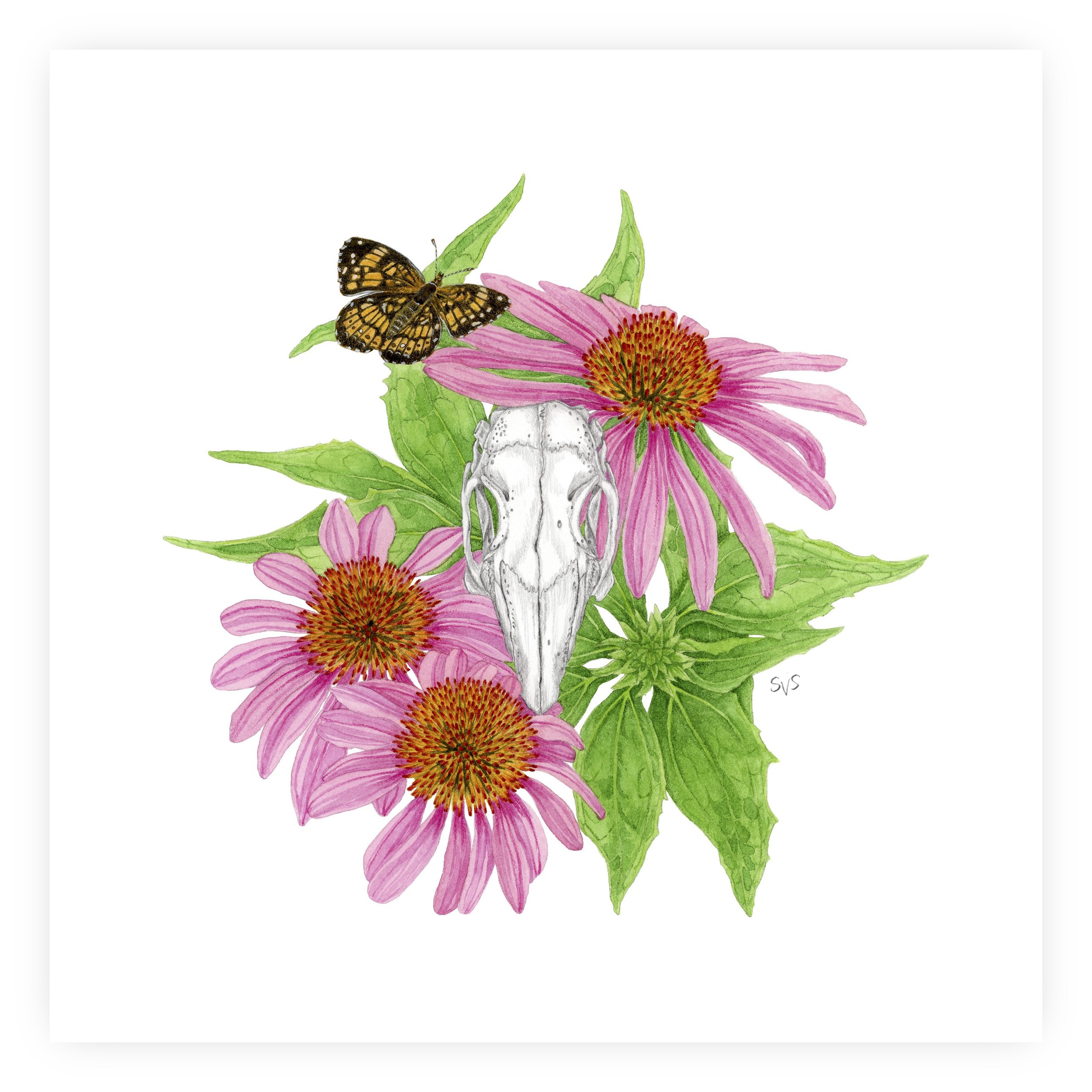
1 of 2: The skull of an Eastern cottontail (Sylvilagus floridanus) is surrounded by purple coneflowers (Echinacea purpurea), a plant that serves as both a food source for the rabbit and an important host plant for the silvery checkerspot butterfly (Chlosyne nycteis).
2 of 2: A baby mountain cottontail (Sylvilagus nuttallii) nestles amongst the foliage of Western chokecherry (Prunus virginiana), a plant that provides an important food source for this species. A Columbia silk moth (Hyalophora columbia) rests nearby, whose caterpillars rely on Western chokecherry as a host plant.
Together, these two pieces explore the interconnected cycles of life, death, and renewal found throughout the natural world. The remains of one rabbit nourish and surround the living world that follows, while a young rabbit begins its own journey within an ecosystem shaped by countless relationships between plants, animals, and insects.
Graphite, watercolor & colored pencil
20” x 10”